

design your own pokemon game
As you can see, all the Pokémon and Energy cards in our example deck are Lightning type.
Choosing Pokémon for Our Deck
After choosing the type of Pokémon to build the deck around, the next step is to choose the Pokémon we want to include. When evaluating a Pokémon, it's important to consider its Hit Points (HP), the damage done by its attacks for each Energy attached to it, any secondary effects of those attacks, and the ease at which the Pokémon can be put into play.
Pikachu & Zekrom-GX is one of the most powerful Lightning-type Pokémon around. For a cost of 3 Lightning Energy, it can do 150 damage to the opponent's Active Pokémon and attach 3 more Lightning Energy to 1 of your Pokémon. Consider the strengths and drawbacks of Pikachu & Zekrom-GX compared with those of Ampharos V or an evolved Pokémon like Morpeko VMAX, and you can quickly see why it's such a popular choice.
As a general rule, every deck should include a cast of Pokémon with attacks or Abilities that complement each other. Boltund V is the perfect partner for Pikachu & Zekrom-GX because the former's Electrify attack can be used to power up the latter's Full Blitz. Plus, Boltund V's Bolt Storm attack does more damage for each Lightning Energy attached to all of your Pokémon. Tapu Koko Prism Star also earns a spot in this deck—its Dance of the Ancients Ability benefits both Pikachu & Zekrom-GX and Boltund V.
Filling Out Your Deck with Search and Draw
Although some decks fall out of this range, most decks include around 12–16 Pokémon, about half of which fill the role of attacker. When choosing Pokémon to include in the deck, priority should be given to those that can be searched for by the same Trainer cards as your main Pokémon. These Pokémon should work well together, and they'll help save space in your deck by not needing their own different sets of supporting cards. If a Pokémon cannot be searched for, then it might be impossible to find when it's needed in battle. Our Lightning-type deck uses Quick Ball, Electromagnetic Radar, and Cherish Ball to search for Pikachu & Zekrom-GX, Boltund V, and Tapu Koko Prism Star. This means the other Pokémon in the deck should also be Basic Pokémon and/or Pokémon-GX.
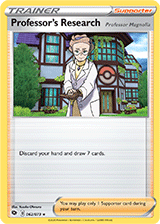
To better the chance that players can access key resources when they need them, all decks should include Supporter cards that draw cards from the deck. Professor's Research and Marnie are two popular examples. Our Lightning-type deck also uses Dedenne-GX's Dedechange Ability and the Speed Lightning Energy Special Energy card to draw more cards. As you can see, being able to get the card you need when you need it is crucial in the Pokémon TCG. It's critical to look beyond ways to get a card at the right time besides simply drawing it at the start of your turn.
Finishing Your Deck
The remaining space in the deck should be dedicated to Trainer cards that enhance the player's strategy or disrupt the opponent's strategy. Trying to do both of these things typically means you're not going to do that well at either one.
This is the portion of the deck that will differ the most between players because it is often a reflection of personal taste. For example, some players may choose to include the Chaotic Swell Stadium card to disrupt their opponent, while others may prefer the Viridian Forest Stadium card to guarantee they have access to the Energy cards required to attack.
Watching for Weakness
The major weakness of a deck comprising one type of Pokémon is…just that! Pokémon of the same type often share a Weakness. This Lightning-type deck would have a difficult time in battle against a deck that attacks with Fighting-type Pokémon, as every Pokémon except Zapdos is weak to Fighting-type attacks.
Discerning deck builders add one or two Pokémon of a different type to their deck in order to mitigate the impact of a single Weakness. It can't just be any Pokémon—it needs to be one that can utilize the same type of Energy cards as the other Pokémon in the deck, and one that is consistent with the deck's overall strategy. For example, this Lightning-type deck could incorporate Mewtwo & Mew-GX or Cramorant V, which are not weak to Fighting-type Pokémon and can use Lightning-type Energy.
Building Your Deck Around Specific Pokémon
Let's take a look at another approach to deckbuilding—focusing the strategy on one or two specific Pokémon rather than a type. The amount and type of Energy required for a Pokémon to attack varies, and you have to figure out how you'll get the Pokémon into play, too. Not surprisingly, this means the decks themselves can vary wildly in the nature and spread of Pokémon, Trainer cards, and Energy cards. Fortunately, there are a few steps that deck builders can follow to make any Pokémon shine. Let's use Polteageist from the Sword & Shield—Darkness Ablaze expansion as an example in our next deck.
design your own pokemon game
Source: https://www.pokemon.com/us/strategy/designing-a-deck-from-scratch/
Posted by: ransomhime2002.blogspot.com
0 Response to "design your own pokemon game"
Post a Comment